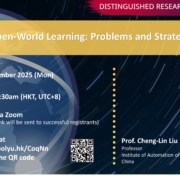
Prof. Cheng-Lin Liu gave a talk on “Open-World Learning: Problems and Strategies”

Traditional methods of pattern classification and machine learning usually assume closed world: the input pattern falls within a fixed set of classes. However, in open world, the input pattern can be of either known or unknown classes, or be outlier. While in training, the data may emerge incrementally, and the new dataset contain samples or with known or unknown classes, either labeled or unlabeled, or be outlier. Such open-world learning scenario involves multiple challenges including out-of-distribution (OOD) detection, confidence estimation, unlabeled data exploitation, catastrophic forgetting and novel category discovery. The challenges are attacked by combining techniques such as generative modeling, regularization, knowledge distillation, and hybrid learning. This talk will outline the status of open-world pattern recognition, identify the main challenges of open-world learning and main strategies, and present some recent progress achieved in my group: open-set recognition, class-incremental learning, and generalized category discovery.


Welcome one new PhD student to join the group!

The group for risk, reliability, and resilience informatics of intelligent systems warmly welcomes Hang Ji to join the team to start his PhD study journey.

Research project funded by the Natural Science Foundation of Shenzhen-General Program

Uncertainty quantification and spatiotemporal causal discovery for reliable traffic prediction

Research paper accepted by INFORMS Journal on Computing

Accurate and reliable prediction has profound implications to a wide range of applications, such as hospital admissions, inventory control, route planning. In this study, we focus on an instance of spatio-temporal learning problem–traffic prediction–to demonstrate an advanced deep learning model developed for making accurate and reliable prediction. Despite the significant progress in traffic prediction, limited studies have incorporated both explicit (e.g., road network topology) and implicit (e.g., causality-related traffic phenomena and impact of exogenous factors) traffic patterns simultaneously to improve prediction performance. Meanwhile, the variability nature of traffic states necessitates quantifying the uncertainty of model predictions in a statistically principled way; however, extant studies offer no provable guarantee on the statistical validity of confidence intervals in reflecting its actual likelihood of containing the ground truth. In this paper, we propose an end-to-end traffic prediction framework that leverages three primary components to generate accurate and reliable traffic predictions: dynamic causal structure learning for discovering implicit traffic patterns from massive traffic data, causally-aware spatio-temporal multi-graph convolution network (CASTMGCN) for learning spatio-temporal dependencies, and conformal prediction for uncertainty quantification. In particular, CASTMGCN fuses several graphs that characterize different important aspects of traffic networks (including physical road structure, time-lagged causal effect, contemporaneous causal relationships) and an auxiliary graph that captures the effect of exogenous factors on the road network. On this basis, a conformal prediction approach tailored to spatio-temporal data is further developed for quantifying the uncertainty in node-wise traffic predictions over varying prediction horizons. Experimental results on two real-world traffic datasets of varying scale demonstrate that the proposed method outperforms several state-of-the-art models in prediction accuracy; moreover, it generates more efficient prediction regions than several other methods while strictly satisfying the statistical validity in coverage.