Congratulations on Long XUE to pass his PhD oral defense!!!

Principled quantification of predictive uncertainty in deep neural networks is crucial for ensuring reliable performance and trustworthy deployment in open-world environments. This thesis presents three complementary methodologies that advance uncertainty quantification and facilitate responsible utilization of deep learning in open-world settings.

First, we propose a continuous optimization framework for constructing neural network (NN)–based prediction intervals (PIs). The proposed method formulates PI construction as a differentiable optimization problem that explicitly prioritizes target coverage while minimizing the width of PIs. By incorporating distance-based differentiable constraints, a shared-bottom architecture, gradient-conflict mitigation, and a coverage–width–aware early stopping mechanism, the approach yields significantly tighter intervals than state-of-the-art PI methods.

Second, we develop an uncertainty-informed risk management framework for open-world environments using spectral-normalized neural Gaussian processes. Our method combines distance-preserving representation learning with a distance-aware output layer to yield Gaussian process-like, distance-sensitive uncertainty estimates. Through a well-defined thresholding mechanism based on Youden’s index, uncertainty estimates are translated into actionable risk levels, enabling reliable uncertainty-aware decision making across normal, shifted, and Out-of-Distribution (OOD) conditions.

Third, we propose a unified framework that integrates conformal prediction with distance-based OOD detection. By filtering OOD inputs and optimizing prediction set size, the method seek to preserve the statistical guarantee of conformal prediction while yielding tighter, more informative prediction sets. Computational experiments demonstrate competitive OOD detection performance and substantial reductions in the average prediction-set size, all achieved efficiently within a single forward pass through the neural network.

Collectively, this thesis advances uncertainty estimation from isolated modeling techniques to an end-to-end framework for reliable deep learning in open-world settings. The proposed methodologies provide practical pathways for the responsible and dependable deployment of deep learning models in real-world applications.


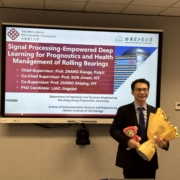
Congratulations on Jingxiao LIAO to pass his PhD oral defense!!!

In recent years, deep learning has achieved significant success in various fields, including natural language processing, autonomous driving, and computer vision. In the realm of prognostics and health management (PHM) for rolling bearings in rotating machinery—such as aero engines, wind turbines, and high-speed trains—numerous intelligent PHM methodologies have emerged to provide accurate and adaptable machinery fault diagnostics and prognostics. However, methodologically speaking, there is no one-size-fits-all approach. It is widely acknowledged that these data-driven approaches still possess considerable limitations, hindering their widespread adoption in industrial settings.

Three primary challenges persist: (1) the lack of interpretability in deep learning methods, particularly in machinery fault diagnosis, where diagnostic models must be transparent to foster trust in the results and inform maintenance decisions; (2) the limited generalizability and reliability of bearing remaining useful life (RUL) prediction models. When training data is scarce, even under identical operating conditions and with the same bearing types, current RUL models demonstrate suboptimal accuracy. In addition, ensuring the reliability of RUL predictions is an important consideration for making informed maintenance decisions in real-world scenarios; and (3) the difficulty in deploying intelligent diagnosis models to edge devices, which hinders their integration into real-world industrial settings.

Therefore, this dissertation aims to address these challenges by constructing the paradigm of integrating traditional signal processing and modern deep learning methods. We formally define this approach as signal processing-empowered neural networks, which synthesize the complementary strengths of both domains. This framework provides three key advantages: (1) integrating rigorous signal processing theory to improve model interpretability; (2) leveraging the robust feature representation capabilities of signal processing techniques to enhance deep learning model generalizability and auxiliary exponential model to quantify the reliability of RUL predictions; and (3) enabling faster computation and greater accuracy, thereby facilitating the edge device deployment of lightweight models. The research contents are summarized as follows:

Welcome one new PhD student to join the group!

The group for risk, reliability, and resilience informatics of intelligent systems warmly welcomes Hang Ji to join the team to start his PhD study journey.

Welcome Ruohan Li to join our group as a research assistant!

We are pleased to welcome Ruohan Li, who recently joined our group as a research assistant. Ruohan Li holds a Bachelor’s degree in Economics and Finance from the University of Toronto and a Master’s degree in Business Analytics from Ivey Business School at Western University.

Welcome Shuaiqi Yuan to join as a postdoctoral research scholar!

We are pleased to welcome Dr. Shuaiqi Yuan, who recently joined our group as a postdoctoral research scholar. Dr. Yuan holds a PhD in Safety and Security Science from Delft University of Technology in the Netherlands.

Welcome two new PhD students to join the group!

The group for risk, reliability, and resilience informatics warmly welcomes the following PhD students to join the team:

Tao Wang, and Xinru Zhang.

Welcome five new PhD students to join the group!

The group for risk, reliability, and resilience informatics warmly welcomes the following PhD students to join the team:

Yanwen Jin, Ruonan Zhu, Chenyu Li, Pingping Dong, Jingxiao Liao.